
Science becomes interesting when it changes how we see something familiar: the light from a distant star, the electronics in our hands, or the energy powering our homes. If you searched for shockicon com science discoveries, you probably want accessible explanations that connect scientific ideas with real life. This guide explains what Shockicon’s science section offers, explores two well-documented research milestones, and shows how to separate an exciting headline from a discovery supported by evidence.
What Is Shockicon’s Science and Discoveries Section?
Shockicon presents itself as a website covering science, technology, and innovative entertainment. Its science archive includes explanations of balanced forces and stimuli, alongside articles about science centers, planetariums, and museum experiences. That makes it a broad reading destination rather than a narrowly focused collection of research papers.
For readers exploring shockicon com science discoveries, this distinction helps set expectations. An introduction to a scientific concept serves a different purpose from reporting a newly published experiment. Both can be useful, provided the article makes that purpose clear.
The archive also contains subjects outside conventional discovery reporting, including interior design. Readers should therefore assess individual articles on their sources and explanations instead of assuming that every entry describes a scientific breakthrough.
Start With the Difference Between Learning and Discovery
Learning something new to you is rewarding, but it is not necessarily new to science. A description of gravity may explain established knowledge. A research paper might test an unresolved question about how gravity behaves under particular conditions.
When browsing shockicon com science discoveries, ask whether an article is explaining an accepted principle, describing a practical technique, or reporting new evidence. These categories require different kinds of support.
An educational explainer needs accurate definitions and helpful examples. A discovery report also needs the researchers’ names, the study date, the methods, and a clear account of what remains uncertain. Without those details, readers cannot easily judge how much a headline actually establishes.
Space Research: Reading the Chemistry of Distant Worlds
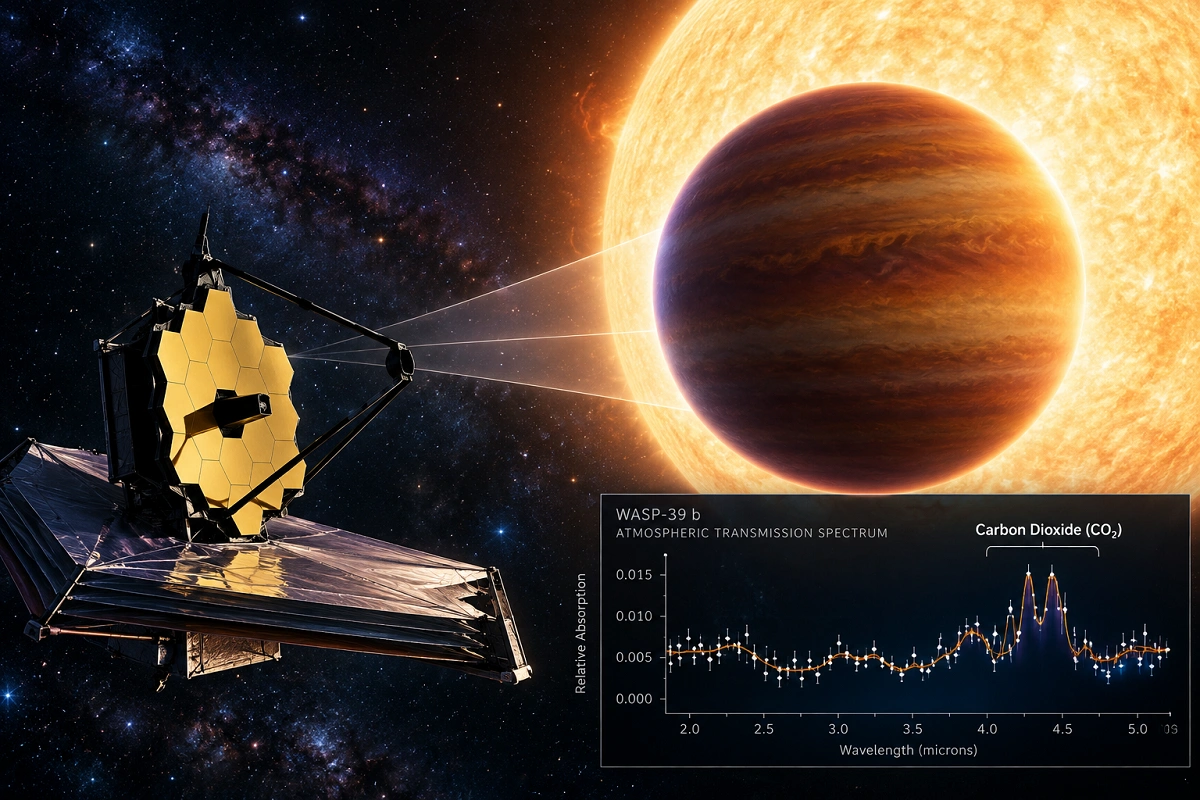
Some discoveries begin with light that has traveled hundreds of years to reach us. In August 2022, NASA reported that the James Webb Space Telescope had detected clear evidence of carbon dioxide in the atmosphere of WASP-39 b, a gas giant roughly 700 light-years away.
Scientists examined starlight passing through the planet’s atmosphere during a transit. Different gases absorb particular wavelengths, leaving patterns that help researchers identify atmospheric ingredients. This approach allows astronomers to investigate worlds they cannot visit.
For anyone interested in shockicon com science discoveries, this is a useful example of evidence behind a dramatic space headline. Detecting carbon dioxide reveals something about atmospheric chemistry; it does not, by itself, establish that a planet supports life.
The broader importance lies in the method. Better atmospheric measurements help researchers investigate how planets formed and how their environments differ. The achievement is impressive without adding unsupported claims about alien organisms or habitable worlds.
Energy Research: Understanding the Fusion Milestone
Energy stories often attract sweeping promises, so precise wording matters. On December 5, 2022, researchers at Lawrence Livermore National Laboratory’s National Ignition Facility achieved a major fusion milestone. Their experiment produced 3.15 megajoules of fusion energy from 2.05 megajoules of laser energy delivered to the target.
The comparison concerns energy reaching the target. It does not mean the entire facility generated more usable electricity than it consumed. Calling this result a working commercial power station would go beyond what the experiment demonstrated.
When reading shockicon com science discoveries or any other science coverage, notice exactly what a measurement includes. “More energy out than in” sounds straightforward, but its meaning depends on where researchers draw the boundary.
The result matters because it demonstrated an important physical achievement. Turning experimental success into an economical energy supply requires additional engineering progress. Appreciating the milestone and recognizing the remaining work are both part of understanding the science.
Why Museums and Everyday Examples Belong in Science Reading
Not every worthwhile science article needs a telescope or an advanced laboratory. Shockicon’s archive also features science centers, planetariums, and the Museum of Discovery and Science. These subjects connect scientific ideas with places readers can explore.
Use these features as starting points for questions. What does an exhibit let you observe? Which explanation does it illustrate? Could you describe the principle afterward without repeating the display text?
An everyday example can be equally productive. Think about a book resting on a table: being motionless does not mean no forces act on it. Examples like this invite readers to examine ordinary surroundings more carefully.
A useful way to approach shockicon com science discoveries is to connect each article with one observation, question, or activity. That turns casual browsing into active learning.
How to Check a Science Article Before Trusting It
You do not need specialist training to perform a few useful checks. Start with the central claim and work backward toward the evidence.
- Find the original source. Look for a research paper, university announcement, laboratory report, or official mission update.
- Check the dates. Separate the experiment’s date from the article’s publication or update date.
- Identify what was studied. A computer simulation, laboratory sample, and field observation answer different questions.
- Read the limitations. Notice uncertainty, measurement boundaries, and alternative explanations.
- Compare the headline with the findings. The headline should not promise more than the underlying evidence supports.
Apply this checklist when using shockicon com science discoveries as a reading starting point. Following the source link often answers the most important question: what did researchers actually demonstrate?
Also distinguish evidence from predictions. A possible future application can explain why research matters, but it should remain clearly separate from a result already achieved.
Build a Reading Habit That Improves Understanding
Choose one subject at a time. If a space article introduces spectroscopy, learn that term before moving to another story. If an energy report discusses efficiency, identify which inputs and outputs are being compared.
Keep a short note with three prompts: What was learned? How was it measured? What is still unknown? This creates a useful record without turning reading into homework.
Try explaining the discovery aloud in two sentences. If you cannot explain the connection between the evidence and the conclusion, return to that part of the source. Confusion often reveals the most valuable question to investigate next.
The lasting value of shockicon com science discoveries depends on how thoughtfully you use what you read. Follow interesting ideas, check important claims, and leave room for uncertainty. Science becomes more rewarding when a headline starts an investigation rather than ending one.